
Quick answer
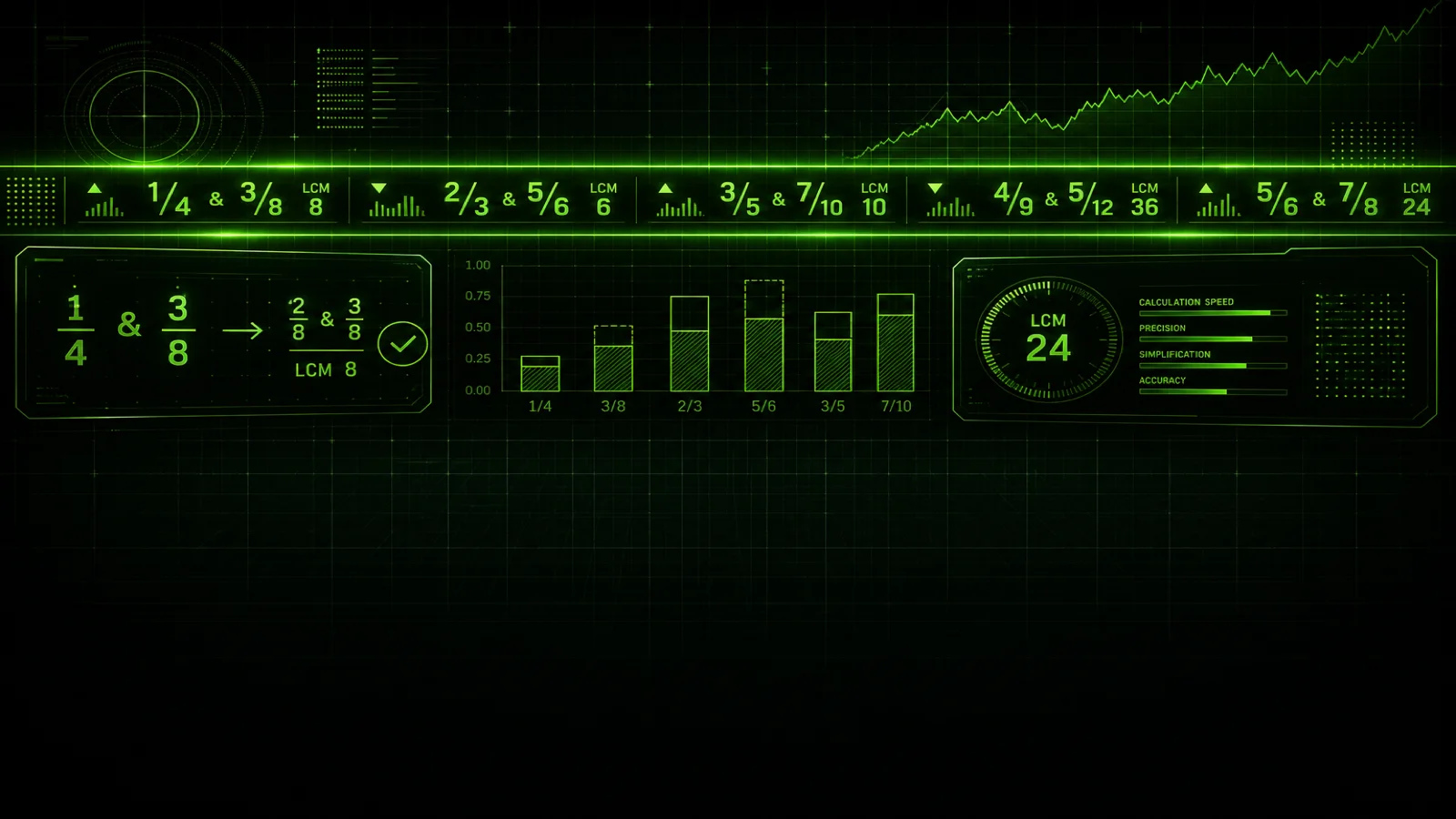
For denominators b and d, LCD equals lcm(b, d). LCM is the general multiple concept; LCD names that value when working with fractions.
Formula
- LCD = lcm(denominators)
- LCM: smallest shared multiple
- GCF simplifies one fraction, not LCD
Introduction
Textbooks switch between LCD and lcm language. For fraction denominators, the numeric answer is usually the same.
Confusion often comes from using lcm on the wrong set of numbers, such as numerators instead of denominators.
GCF is a separate idea. GCF reduces a single fraction. LCD aligns two fractions before an operation.
Start with the definition in what is the least common denominator if either term feels unfamiliar.
Key differences
LCM describes integers: what is the smallest number that is a multiple of each given whole number?
LCD describes fractions: what is the smallest denominator that lets me rewrite these fractions equally?
Example: lcm(6, 8) = 24. Fractions with denominators 6 and 8 also use LCD 24 when converted.
You would not find lcm of numerators 5 and 3 when the denominators are 6 and 8. That would answer a different question.
For how lcm supports fraction work beyond vocabulary, read least common multiple and LCD.
Mathematical relationship
- LCD(a/b, c/d) = lcm(b, d)
- lcm(b,d) = |b×d|/gcd(b,d)
- Not lcm(a, c) for LCD
The relationship is an application: fraction context renames lcm of denominators as LCD.
On word problems, write "lcm of denominators" in scratch work, then label the same value as LCD in fraction steps.
Standardized tests may use either term. Translate mentally to lcm of bottoms.
Correct usage guide
- Fraction addition or subtraction Say LCD or lcm of denominators. Show equivalent fractions next.
- Integer-only problems Use lcm, not LCD, because no fractions are present.
- Simplifying one fraction Use GCF to divide numerator and denominator.
- Checking your work Use the calculator to confirm lcm of two denominators matches your LCD line.
Numeric match
lcm(9, 12) = 36 using primes: 9 = 3², 12 = 2²×3, combined 2²×3² = 36.
Fractions with denominators 9 and 12 both scale to denominator 36, such as 20/36 and 15/36.
Test 9 and 12 as denominators at /#calculator.