
Quick answer
Each example finds lcm of denominators, scales numerators, and states the LCD. Patterns include unlike, nested, and already-matching denominators.
Formula
- Unlike denominators
- One denominator divides another
- Mixed numbers
- Three denominators together
Introduction
Examples turn the LCD rule into familiar fraction pairs. Seeing the same structure repeatedly helps you recognize which method to use.
Each example below shows denominators, lcm work, equivalent fractions, and the LCD result.
After you study a block, enter the same numbers in the calculator to build confidence.
If you need the full procedure first, review how to find the least common denominator before working through the table of examples.
Two-fraction examples
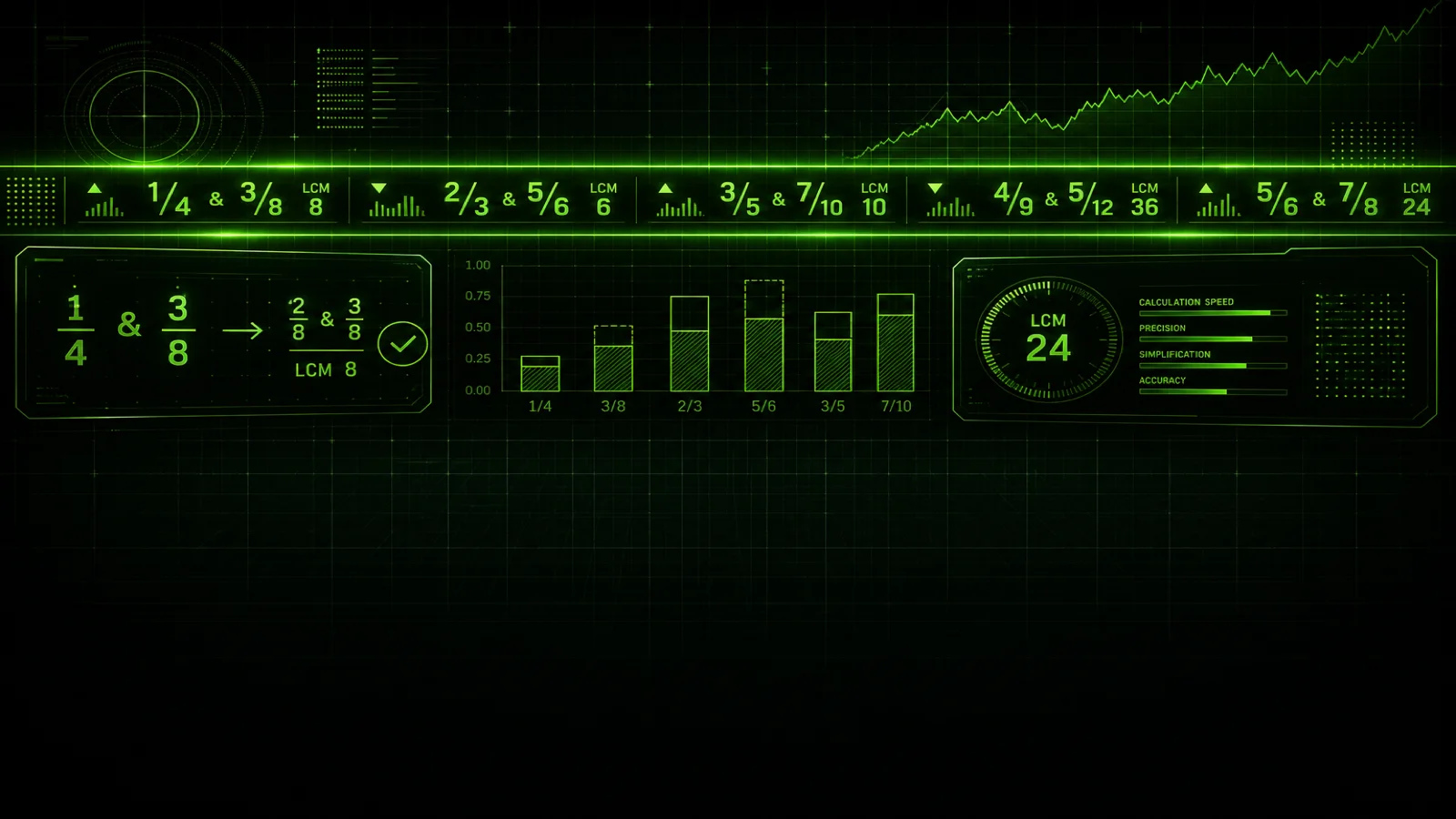
Unlike denominators: 1/4 and 2/3. lcm(4, 3) = 12. Equivalents: 3/12 and 8/12.
One divides the other: 5/6 and 1/3. Since 6 is a multiple of 3, LCD = 6. Equivalents: 5/6 and 2/6.
Already matching: 3/8 and 5/8. LCD = 8. No scaling needed; numerators can be added or compared directly.
Larger pair: 7/10 and 4/15. lcm(10, 15) = 30. Equivalents: 21/30 and 8/30.
These patterns cover most introductory worksheets. When the problem asks for a sum, continue with LCD for adding fractions after you align denominators.
Mixed numbers and three denominators
- 1 1/2 and 2 1/4 → LCD 4
- 2 3/5 and 1 2/3 → LCD 15
- 1/2, 1/3, 1/4 → LCD 12
Mixed numbers: for 1 1/2 and 2 1/4, denominators 2 and 4 give LCD 4. Improper forms 3/2 and 9/4 scale to 6/4 and 9/4.
Three denominators: lcm(2, 3) = 6, then lcm(6, 4) = 12. Use LCD 12 for all three fractions: 6/12, 4/12, 3/12.
Real-world: 2/3 cup flour plus 1/4 cup sugar needs LCD 12 (8/12 + 3/12) before adding in a kitchen conversion.
Measurement: 3/8 inch and 1/4 inch share LCD 8 for comparison on a ruler marked in eighths.
Pattern checklist
- Read the problem type Addition, subtraction, or comparison tells you why you need the LCD.
- List every denominator Include all fractions, even when one denominator already divides another.
- Find lcm and state LCD Show one line of method work, not just the final number.
- Write equivalent fractions Keep track of which numerator pairs with which original fraction.
- Finish the operation Add, subtract, compare, then simplify if the result allows.
Try 4/9 and 5/12
Factor view: 9 = 3² and 12 = 2²×3. LCD = 2²×3² = 36.
Scale: 4/9 = 16/36 and 5/12 = 15/36. Adding gives 31/36.
Verify lcm(9, 12) = 36 using the /#calculator fields.